


HISTORY OF FLOWER PAINTING
From an inn by the Alsterån River to an industrial heart in Småland


What does the name mean?
The name Blomstermåla bears traces of a long history. The suffix -måla is common in Småland and southeastern Sweden and goes back to the Old Swedish word male. The word was used for a measured or delimited area of land and appears in many place names that arose in connection with medieval new cultivation and new settlements.
The first part of the name, Blomster-, is more difficult to explain with certainty. It is tempting to associate it with flowers and the lush nature around the Alsterån River, but the exact origin of the name is not clearly established.
Together, the name tells of the place's ancient roots – while Blomstermåla has today become a name strongly associated with the community on the Alsterån River.

From village to community
Blomstermåla's history begins long before the railway and industry came to define the town. The area around the Alsterån River and Högsbyåsen has been important to people for a very long time. Finds of axes and arrowheads in and around Blomstermåla show that people lived here as early as the Stone Age.
Over time, Högsbyåsen became a natural route through the landscape. The old Stockholm Road, dating back to the Middle Ages, ran here, which developed into an important transport route through southeastern Sweden. All around, forests and farmland spread out, with farms and smaller settlements – still a long way from the cohesive community we know as Blomstermåla today.
At the same time, the Alsterån River flowed through the landscape, whose flowing water and head would later have great significance for the development of the town. Water power was first used for mills and sawmills, among other things, and eventually became an important prerequisite for industry. Together, the river, the old routes and the location of the place created the foundation for the development that during the 19th century and especially the 20th century would transform Blomstermåla from a rural area into a growing community.
The railway changed Blomstermåla
When the railway between Kalmar and Berga was inaugurated in 1897, a new era began for Blomstermåla. The originally narrow-gauge railway gave the town significantly better connections with Kalmar and the regional railway network. Blomstermåla developed increasingly clearly into a station community – and the railway became an important driving force behind the town's growth.
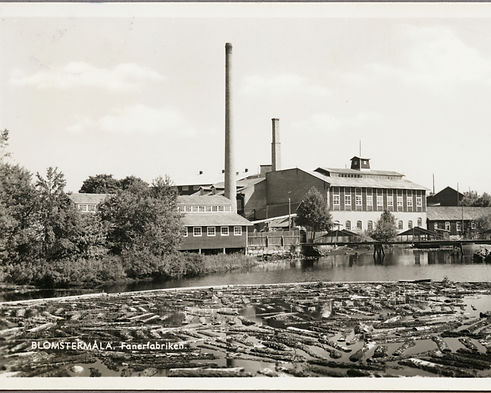
The new transport options made it easier to transport both raw materials and finished products and created good conditions for new industries. Together with the Alsterån hydroelectric power and the existing roads, the railway made Blomstermåla an attractive place for business establishment. Around the turn of the century, veneer and furniture industries, among others, grew up, and later more significant industrial companies followed. Many businesses were established in the area between the railway and the Alsterån, which is still an important part of Blomstermåla's industrial cultural heritage today.
With the industries and new jobs, the population also grew. In the second half of the 19th century, Blomstermåla consisted of around 75 homes, but by 1940 the population had grown to 1,045 people. In just a few decades, the small town had developed into a growing industrial community.


The industry is emerging
At the beginning of the 20th century, Blomstermåla changed rapidly. The location had unusually good conditions for industry: the Alsterån provided access to hydroelectric power, the railway made it possible to transport raw materials and finished products, and the old country roads connected Blomstermåla with the surrounding area. Along the river, hydroelectric power had also been used for mills and sawmills long before modern industry emerged.
Around the turn of the century, wood, veneer and furniture industries were established. Companies such as Bohman & Johansson, Blomstermåla Möbelfabrik and Åfors Möbelfabrik left a clear mark on the town's industrial history. Bohman & Johansson began veneer production in Blomstermåla as early as 1897. Later, the engineering and metal industry also grew, including through Norrbackens Mekaniska Verkstad, which eventually developed into Norba, and through BEVI.
The industries created jobs and attracted more people to Blomstermåla. New residential areas sprang up as the need for labor increased, and many of the businesses were concentrated in the area between the Alsterån River and the railway. In this way, Blomstermåla did not develop primarily around a church or a square, like many older communities, but to a large extent around work, transportation routes, and industry. That structure can still be read in the community today.
Industry became an important part of Blomstermåla's identity. Generations made their living here, businesses developed and products from the small Småland community reached far beyond the village. Blomstermåla had become an industrial community.
The Alsterån River – the lifeblood of society
The Alsterån has long been one of the forces that shaped Blomstermåla. Long before modern industry emerged, the flowing water was harnessed. There were mills and sawmills along the river, and as industrialization took hold, hydropower became increasingly important.
The proximity to the water also influenced where businesses were established. The area between the Alsterån River and the railway in particular developed into an important industrial environment. Here two crucial conditions met: the power from the water and the possibility of transporting raw materials and finished products by railway.
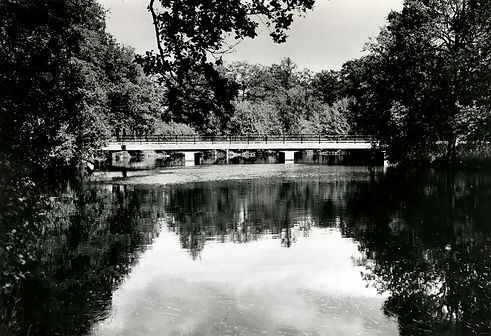
But the Alsterån has always been more than a source of power. The river runs through the landscape and connects nature with the history of the town. The water that once created the conditions for mills, sawmills and industry is today also a valuable natural and recreational environment.
The Alsterån follows the history of Blomstermåla through time – from the work of previous generations to today's nature experiences in the middle of the community.

Flower painting during the 20th century
During the 20th century, Blomstermåla increasingly took on the form that the community has today. Industry and new jobs caused the population to grow, and with the people the town also changed. New homes and residential areas sprang up, roads were developed, and shops and services became part of everyday life.
But a community consists of more than housing and workplaces. Schools, clubs, sports and various meeting places were of great importance to the people who lived here. The clubs created community and gave people the opportunity to meet outside the factories and workplaces.
The People's House became an important meeting place, where people could gather for meetings, culture, events and joint activities. Together with the schools, associations, shops and workplaces, a stronger sense of community grew.
Blomstermåla was no longer just a place where people worked. It had become a community where generations grew up, families created their homes, and people built a life together.
A living history
Blomstermåla's history is not only found in old photographs, factory buildings and dates. Above all, it lives on through the people and their stories – memories of workplaces and school years, shops that once existed, parties, associations, neighbours and meetings.
Each generation has left its mark on Blomstermåla. Buildings have disappeared, businesses have changed and new residential areas have sprung up. At the same time, much of what characterizes the town has been passed down from generation to generation: the community, the commitment and the strong sense of place.
Even today, Blomstermåla's history continues to be written – by the people who live here, work here, get involved and realize new ideas.
History is not just what once was. It is also what we preserve – and what we carry forward together.
